
Navigating Life Transitions - Part 1: The Descent
Major life transitions ask more of us than we sometimes know how to give. Not the practical side of change (the decisions, the plans, the logistics) but the inner passage that opens up alongside it. The one that doesn't come with a roadmap. In the first of a three-part series, I explore what it actually feels like to be in the middle of a significant life transition - the quiet death of an old identity, the disorientation that follows, and the cultural pressure to fix it all as quickly as possible. And why that pressure may be the very thing standing between you and what this passage is asking of you. This is Part 1: The Descent.
Dinusha Koggalahewa
6/3/20263 min read


The hardest part of any major life transition is never the transition itself. It’s the gap that emerges around our sense of identity.
The gap between who we were up until that point, and who we’re yet to be, on the other side of that transition. The challenge is that we don’t yet know who we are becoming yet have a sense that something inside of us is shifting.
Supporting clients through major life transitions makes up a big part of my life coaching work. Not the practical things like making decisions and plans, but the inner passage that opens up for them as part of that transition that doesn’t come with a road map.
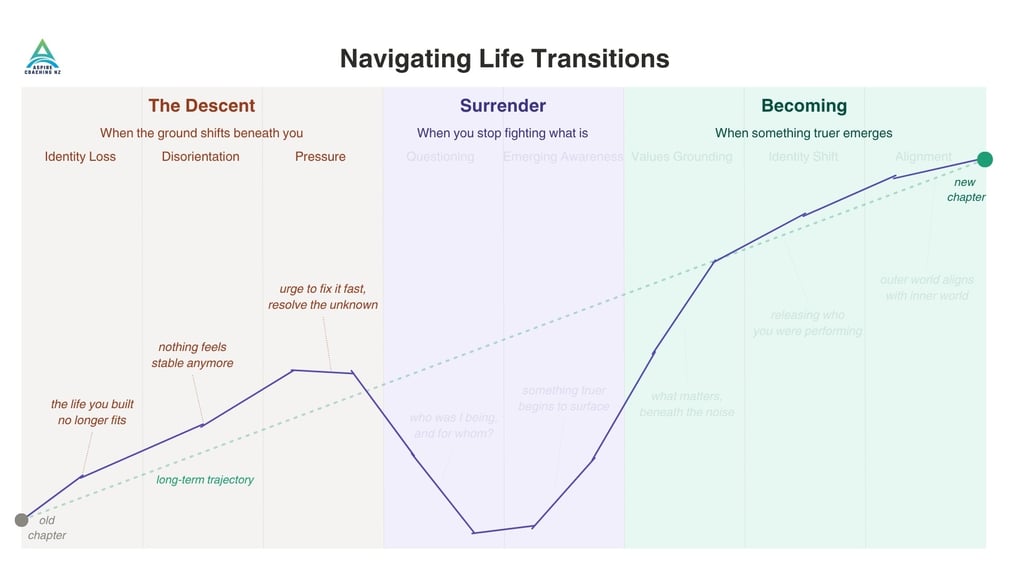
It’s territory I have a fair bit of familiarity with. From navigating through my own, as well as walking alongside others through it. What I’ve come to understand is that this passage through a major life transition moves through three distinct phases: The Descent, Surrender, and Becoming.
In today's post we discuss the first phase: The Descent.
What’s a Transition?
I’m referring to the type of major life events that ask more of us than we know how to, or perhaps are even ready to give. Those events that call for us to do the inner work and walk towards the unknown to bring us up to a whole new level of being.
Some transitions have a clear beginning and an end, like a relationship starting or ending, a job opportunity or loss, or working on a health goal or health scare popping up.
While others come along in a much quieter fashion like the infamous ‘mid-life crisis’. A moment of realisation that the life you've built no longer reflects who you actually are. There’s no one moment that defines a beginning or an end, no clear reason to feel unsettled. It’s just a quiet persisting feeling.
These are the harder passages to navigate because there is no story to explain them. Just an inner sense that something has to change.
Identity Loss
One defining characteristic of such transitions is a quiet death of an old identity. The version of you that made sense up to that point suddenly disappears.
There is a grief that accompanies that loss. It’s a quiet realisation that you’re simply not able to, or not willing to, go back to being that person any more. The loss is real yet it doesn’t come with a story or an event that you can make sense of and explain what actually happened.
Physiologically what's happening is that we are wired to have resolution and certainty in our lives. Transitions deny us that resolution and creates an open loop. When there’s no clear beginning and/or ending, that uncertainty eventually starts to take a toll in the body as well as in the mind.
Disorientation
The loss of identity can feel very unsettling and disorienting. One day you’re moving through life with a reasonable sense of who you are and where you’re heading. Then something shifts, sometimes gradually and sometimes suddenly, and the internal compass you’ve been navigating with stops working. The frameworks you’ve used to make sense of yourself and your place in the world feel out of alignment. What used to feel like solid ground feels like it’s shifting beneath your feet.
What often surprises people is that this unsettling disorientation doesn’t just apply to hardship or loss. Some of the most destabilising transitions come with positive transitions - a promotion, a new relationship, working on a long term goal. They bring along a particular kind of disorientation, a sense of trepidation mixed with excitement about the possibilities that lie ahead.
There’s a tension between the thrill of something new and the grief of the familiar falling away. It can be uncomfortable to sit with but it’s also quietly the place where change begins.
Pressure
Being the performance driven beings that we are, we want to feel in control and ‘be productive’ and tend to want to treat the transition like a problem that needs fixing. So we can get back to normal, and as quickly as possible.
This pressure to move out of it quickly is born from cultural and societal expectations we’ve been conditioned by, and not what we need to learn and grow from these transitions.
The irony is that this very instinct driving us to resolve things quickly is the same instinct that keeps us from doing what this passage asks of us. Which is to stay and resist the urge to escape the uncertainty. To turn towards it, and face it with a little courage because it’s only in that inward passage that the deeper work becomes possible.
That deeper work is where my next post will begin - Part 2: Surrender.
If you recognise yourself somewhere in this passage, I'd be curious to know which part felt most familiar.
Legals
Disclaimer | Privacy Policy | Terms of Use | Cancellation & Refund Policy
© 2022 - 2026 Aspire Coaching NZ. All Rights Reserved